
What Does an IP Rating Mean?
When choosing a lighting fixture, its design, brightness and color temperature are only part of the specification. Where the fixture will be installed also matters.
An IP rating indicates how well an electrical enclosure is protected against the entry of solid objects and water. This is particularly important for lighting installed in bathrooms, gardens, entrances, facades and other environments where moisture or dust may be present.
How to Read an IP Rating
IP stands for Ingress Protection. It is followed by two characters that describe different types of protection.
Using IP65 as an example:
- IP — Ingress Protection
- 6 — Level of protection against solid objects and dust
- 5 — Level of protection against water
The first digit therefore relates to solids, while the second digit relates to water.
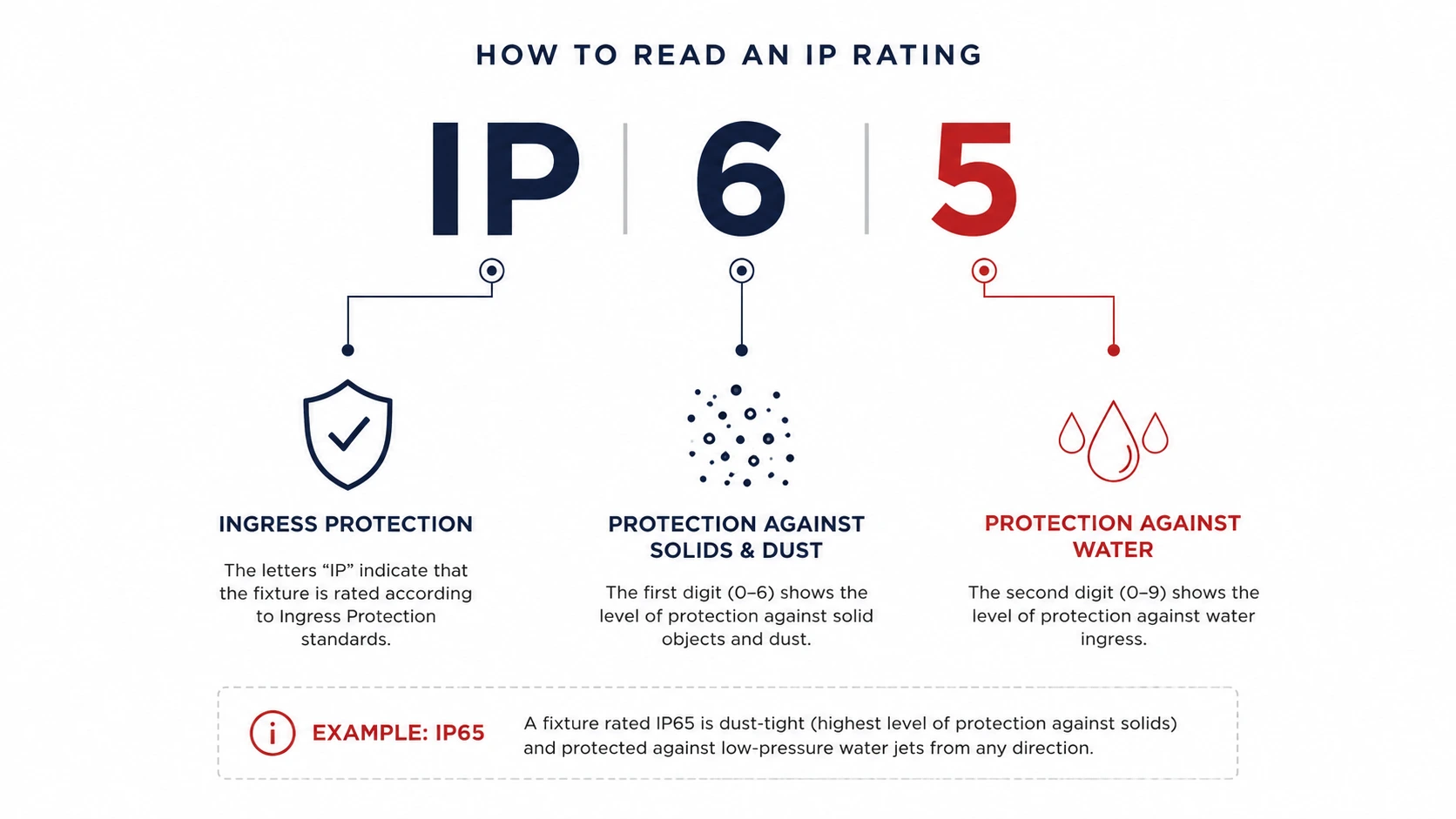
A fixture rated IP65, for example, has the highest numbered level of dust-ingress protection in this classification and is protected against water jets as defined by the applicable test standard.
Key principle: An IP rating does not describe the quality or brightness of a light. It describes the protection provided by its enclosure against specified environmental exposure.
Higher IP Does Not Automatically Mean Better
It is tempting to assume that the highest available IP rating is always the best choice. In practice, the objective is to select a fixture with a rating appropriate for its installation environment.
A decorative light in a dry living room has very different protection requirements from an exposed garden light or an in-ground fixture.
Understanding the First Digit: Solids & Dust Protection
The first digit in an IP rating indicates the enclosure's level of protection against access to hazardous parts and the entry of solid foreign objects.
For lighting, the scale runs from 0 to 6, with higher numbers representing progressively greater protection.
First Digit — Solid Protection Levels
| First Digit | Protection |
|---|---|
| 0 | No protection |
| 1 | Protected against solid objects ≥ 50 mm |
| 2 | Protected against solid objects ≥ 12.5 mm |
| 3 | Protected against solid objects ≥ 2.5 mm |
| 4 | Protected against solid objects ≥ 1 mm |
| 5 | Dust-protected — some dust may enter, but not enough to interfere with operation |
| 6 | Dust-tight — no ingress of dust under the specified test conditions |
What Matters Most for Lighting?
For typical indoor decorative lighting, protection against dust is often less demanding because the fixture operates in a controlled environment.
The requirement changes when fixtures are installed in gardens, exposed facades, workshops or other dusty environments.
This is why many outdoor fixtures use ratings beginning with 5 or 6, such as IP54, IP65 or IP67.
Notice that IP65 and IP67 both begin with 6. Their protection against dust is therefore at the same classification level; the difference between them comes from the second digit — water protection.
Quick rule: Read the two digits independently. A higher second digit does not mean the fixture has greater dust protection.
Understanding the Second Digit: Water Protection
The second digit in an IP rating indicates the enclosure's level of protection against water ingress.
For lighting, this is especially important in bathrooms, covered exterior areas, gardens, exposed facades and in-ground installations, where the type and intensity of water exposure can vary considerably.
Second Digit — Water Protection Levels
| Second Digit | Protection |
|---|---|
| 0 | No protection |
| 1 | Protected against vertically falling water drops |
| 2 | Protected against falling water drops when tilted up to 15° |
| 3 | Protected against spraying water |
| 4 | Protected against splashing water |
| 5 | Protected against water jets |
| 6 | Protected against powerful water jets |
| 7 | Protected against temporary immersion in water |
| 8 | Protected against continuous immersion under conditions specified by the manufacturer |
What Does This Mean for Lighting?
The second digit explains many of the practical differences between common lighting ratings.
IP44
The 4 indicates protection against splashing water. This can suit certain sheltered or splash-prone applications when the installation conditions are appropriate.
IP65
The 5 indicates protection against water jets. Combined with the first digit 6, the enclosure is also dust-tight.
IP67
The 7 indicates protection against temporary immersion. This can be relevant to certain in-ground lighting applications where greater water exposure may occur.
IP68
The 8 relates to continuous immersion under conditions specified by the manufacturer. The exact conditions must therefore be checked for the individual product.
Important: IP67 and IP68 do not automatically make a fixture suitable for every pool or underwater application. The fixture must also be specifically designed for the intended installation and operating conditions.
Water Resistance Is Not the Same as Installation Suitability
An appropriate IP rating is only one part of a reliable installation.
For example, an in-ground fixture may have strong protection against water ingress, but drainage, cable connections, installation method and surrounding conditions still affect the complete installation.
Likewise, a fixture installed beneath a covered entrance experiences very different exposure from one mounted on an open facade—even though both are technically outdoors.
Key principle: Select the IP rating according to the actual type of water exposure the fixture will face.
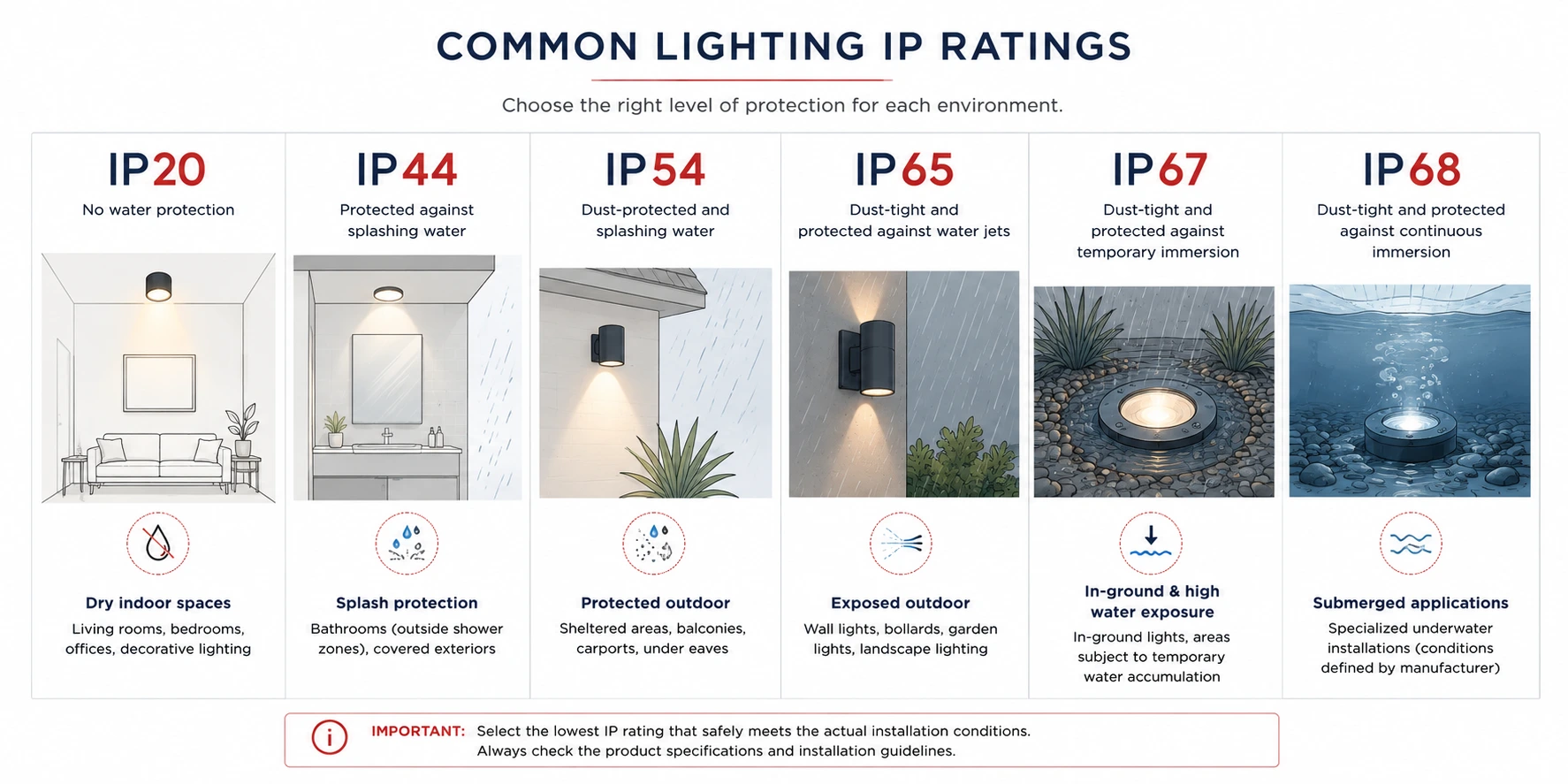
Common Lighting IP Ratings
The easiest way to use IP ratings in practice is to compare the combinations that appear most often in lighting.
Common Ratings at a Glance
| IP Rating | What It Means | Typical Lighting Use |
|---|---|---|
| IP20 | Protected against solid objects over 12.5 mm; no water protection | Dry indoor spaces such as living rooms, bedrooms and many decorative fixtures |
| IP44 | Protected against solid objects over 1 mm and splashing water | Bathrooms outside direct spray zones and sheltered exterior applications where appropriate |
| IP54 | Dust-protected and protected against splashing water | Protected outdoor areas and some semi-exposed applications |
| IP65 | Dust-tight and protected against water jets | Exposed outdoor wall lights, bollards, garden fixtures and many landscape applications |
| IP67 | Dust-tight and protected against temporary immersion | In-ground lighting and locations with higher potential water exposure |
| IP68 | Dust-tight and protected against continuous immersion under specified conditions | Specialized submerged applications when the fixture is specifically designed for them |
IP20 — Dry Indoor Lighting
IP20 is common for interior fixtures installed in controlled dry environments.
It is suitable for many:
- Living rooms
- Bedrooms
- Dining areas
- Offices
- Interior decorative lighting
The lack of water protection means it should not be treated as suitable for wet or exposed locations.
IP44 — Splash Protection
IP44 introduces meaningful water protection and is often encountered in sheltered exterior or bathroom applications.
It can be appropriate where occasional splashing is expected, but it should not automatically be treated as suitable for fully exposed outdoor conditions.
IP54 — Protected Outdoor Applications
IP54 combines dust protection with resistance to splashing water.
It can suit protected exterior locations where the fixture is not subjected to strong direct water jets or immersion.
IP65 — Exposed Outdoor Lighting
IP65 is one of the most common ratings for exposed exterior lighting.
Its 6 means the enclosure is dust-tight, while its 5 provides protection against water jets.
This makes IP65 common among:
- Outdoor wall lights
- Bollards
- Garden spike lights
- Landscape fixtures
- Exposed architectural lighting
IP67 — In-Ground & Higher Water Exposure
IP67 adds protection against temporary immersion while retaining dust-tight construction.
This makes it relevant to certain in-ground and landscape applications where temporary water accumulation may occur.
IP68 — Specialized Submerged Applications
IP68 relates to continuous immersion under conditions specified by the manufacturer.
That final phrase matters. IP68 alone does not define the permitted depth, duration, temperature or specific installation environment. Those conditions must be checked for the actual fixture.
Selection principle: Choose the lowest IP rating that safely and appropriately meets the real installation conditions. Higher protection is useful only when the environment requires it.
Which IP Rating Should You Choose?
The best IP rating depends on the actual installation environment, not simply whether the fixture is indoors or outdoors.
Dry Indoor Spaces
For living rooms, bedrooms, dining areas and most dry interior spaces, IP20 is commonly sufficient.
Bathrooms & Splash-Prone Areas
Bathrooms need more careful selection because water exposure varies by location. Fixtures farther from direct water sources may use lower ratings, while areas closer to showers or baths require greater protection.
For mirror lighting and fixture placement, use the Bathroom Lighting Guide. Product suitability must still be checked for the precise location and installation conditions.
Covered Exterior Areas
Covered entrances, balconies and sheltered terraces may have lower exposure than open gardens or facades.
Depending on the installation, ratings such as IP44 or IP54 may be appropriate.
Exposed Outdoor Areas
For fixtures installed directly in rain or open landscaping, IP65 is a common choice because it combines dust-tight construction with protection against water jets.
Typical applications include:
- Outdoor wall lights
- Bollards
- Garden spike lights
- Landscape fixtures
In-Ground Applications
In-ground fixtures are exposed to more demanding conditions, including water accumulation around the installation.
IP67 is commonly used where temporary immersion protection is required, but the installation method and drainage remain just as important as the fixture rating itself.
Submerged Applications
Fixtures used in pools, fountains or other submerged environments require products specifically designed for continuous immersion and the intended installation conditions.
An IP68 rating alone should not be treated as automatic approval for every underwater application.
Practical rule: Choose the IP rating based on actual exposure, then verify the product specifications and installation requirements for the specific fixture.
IP65 vs IP67: What’s the Difference?
IP65 and IP67 are both commonly used for outdoor lighting. Since both ratings begin with 6, they provide the same classification level for solid ingress: dust-tight protection.
The difference is the second digit—the level of protection against water.
| IP65 | IP67 | |
|---|---|---|
| Dust protection | Dust-tight | Dust-tight |
| Water protection | Water jets | Temporary immersion |
| Typical lighting use | Exposed outdoor fixtures | In-ground / higher water exposure |
| Immersion protection | No | Yes, temporary |
When Is IP65 Appropriate?
IP65 is commonly suitable for exposed outdoor fixtures that need to withstand rain and water jets without being submerged.
Typical examples include wall lights, bollards, garden spike lights and other landscape fixtures.
When Is IP67 Appropriate?
IP67 adds protection against temporary immersion, making it relevant where water may temporarily accumulate around the fixture.
This is particularly important for certain in-ground lights and other installations subject to greater water exposure.
Is IP67 Better Than IP65?
Not necessarily.
For a wall light exposed to rain, IP65 may already provide the appropriate protection. Moving to IP67 provides an additional type of water protection that the installation may never require.
Conversely, an in-ground fixture installed where temporary water accumulation is possible may benefit from IP67 protection.
The difference is not “good vs better.” It is water jets vs temporary immersion. Choose according to the installation.
For more guidance on selecting fixtures for exterior environments, read our Outdoor Lighting Guide: How to Choose Lights for Gardens, Entrances & Facades.
Common IP Rating Mistakes to Avoid
Understanding the numbers is useful, but several common mistakes can still lead to the wrong fixture being selected.
1. Assuming a Higher IP Rating Is Always Better
A higher rating provides additional protection, but that protection may not be necessary for the installation.
Better approach: Match the rating to the actual environmental exposure.
2. Treating All Outdoor Areas the Same
A covered entrance and an exposed garden may both be outdoors, but they experience very different levels of rain, dust and moisture.
Better approach: Assess each installation location individually.
3. Confusing IP65 With Waterproof
IP65 provides protection against water jets; it does not provide immersion protection.
Better approach: Use the second digit to understand exactly what type of water exposure the enclosure is designed to withstand.
4. Assuming IP67 or IP68 Means Pool-Safe
An immersion rating alone does not establish suitability for every underwater environment.
Better approach: For submerged applications, verify that the fixture is specifically designed for the intended depth, duration and installation conditions.
5. Ignoring the Installation
A suitable fixture can still be compromised by poor drainage, inappropriate cable connections or incorrect installation.
This is particularly important with in-ground lighting, where water can accumulate around the fixture.
Key principle: The IP rating protects the fixture enclosure under specified conditions. A reliable lighting installation depends on both the correct fixture and the correct installation.
Final IP Rating Checklist
Before selecting a lighting fixture, check these five points:
✓ Where will it be installed? — Dry indoor, sheltered, exposed outdoor, in-ground or submerged.
✓ What will it be exposed to? — Dust, moisture, splashing, rain, water jets or temporary immersion.
✓ Does the IP rating match that exposure? — Read the solids and water digits independently.
✓ Is the fixture designed for the application? — An IP rating alone does not determine suitability for every environment.
✓ Are the installation conditions appropriate? — Consider drainage, connections, mounting and the manufacturer's installation requirements.
Remember: Don't choose an IP rating because the number is higher. Choose it because the protection matches the environment.
Find the Right Lighting for Your Project
For exterior applications, explore our Outdoor Lighting collection for garden, pathway, facade and architectural lighting solutions.
For a broader explanation of fixture placement, beam angles, color temperature and exterior lighting design, read our Outdoor Lighting Guide.
Planning a Lighting Project?
For residential, commercial or landscape projects requiring product selection or lighting support, contact Saleh Deco and share your project requirements with our team.
The right IP rating is not the highest number—it is the right protection for the right environment.