
Replacing older lighting with LED can reduce electricity consumption, but the financial result depends on more than the wattage printed on the lamp or fixture.
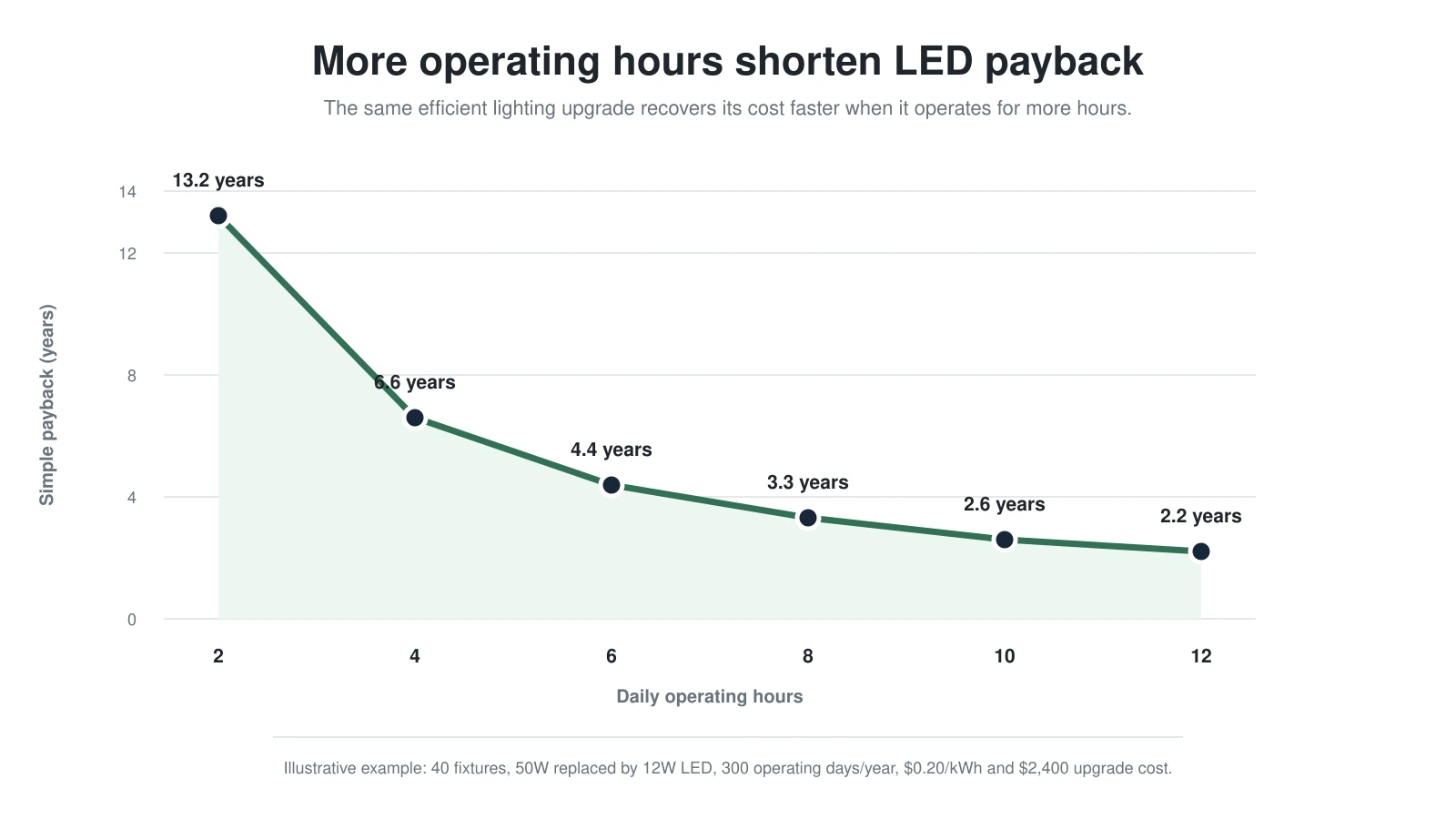
The number of lights, their actual system wattage, operating schedule, electricity rate and replacement cost all affect the result. A light used for twelve hours each day will recover its cost much faster than the same light used occasionally.
This guide explains how to calculate:
- Existing lighting energy consumption
- Proposed LED energy consumption
- Annual electricity savings
- LED upgrade costs
- Simple payback period
- Long-term operating savings
The calculations can be used for a single room, an entire home, a retail space, an office or a larger commercial lighting upgrade.
1. Where Do LED Lighting Savings Come From?
LED lighting can reduce operating costs in several ways.
Lower connected wattage
The most direct saving comes from using less electrical power to produce the required amount of light. For example, replacing a 50W lamp with a suitable 12W LED reduces connected wattage by 38W whenever the light operates.
The comparison must be based on fixtures that provide suitable light output and distribution. A lower-wattage product is not a valid replacement if it leaves the space underlit or produces the wrong beam.
For a clearer explanation of light output and illumination, see the Lux vs Lumens Lighting Guide.
Fewer operating hours
Lighting controls can create additional savings by reducing operating hours or average power. Occupancy sensors, schedules, daylight-responsive controls and dimming are explained later in this guide.
Lower maintenance requirements
LED lamps and luminaires may operate longer between replacements than many older light sources. This can reduce the cost of replacement lamps, labour and access equipment, particularly in commercial spaces or installations with difficult-to-reach fixtures.
Maintenance savings should be calculated separately from electricity savings because product lifetime, installation conditions and maintenance costs vary between projects.
Reduced cooling demand
Lighting converts electrical energy into heat. Reducing lighting power can therefore lower the heat added to an air-conditioned space.
This may produce additional cooling savings, but it should not be treated as a fixed percentage of the lighting saving. The result depends on the climate, operating schedule, HVAC system and whether the space is being cooled.
Important: Energy efficiency does not automatically guarantee comfortable or suitable lighting. Colour rendering, glare, flicker, beam distribution and colour consistency should also be checked when selecting the replacement. See Light Quality Explained.
2. Information Needed Before You Calculate
Collect the following information for both the existing lighting and the proposed LED system.
| Input | What to record | Why it matters |
|---|---|---|
| Fixture quantity | Number of lamps or luminaires | Multiplies the total connected load |
| System wattage | Actual watts consumed by each complete fixture | Determines energy consumption while operating |
| Operating hours | Average hours used each day, week or year | Determines annual running time |
| Operating days | Number of days used each year | Separates residential and commercial schedules |
| Electricity rate | Cost for each kilowatt-hour | Converts energy use into operating cost |
| Replacement cost | Products, installation and related upgrade costs | Required for the payback calculation |
| Expected maintenance | Lamp changes, labour and access costs | Helps estimate wider operating savings |
Use complete system wattage
Where possible, use the input wattage of the complete lamp or luminaire, including its driver, ballast or other control gear.
The LED chip wattage alone may not represent the total power drawn from the electrical supply. Product specifications, driver labels or measured system power provide a more useful basis for comparison.
Compare equivalent lighting results
Before comparing costs, confirm that the proposed LED solution can provide the required:
- Light output
- Illuminance at the working surface
- Beam angle and distribution
- Colour temperature
- Colour rendering
- Glare control
- Dimming or control compatibility
An upgrade that consumes less power but fails to light the space properly is not an equivalent replacement.
3. Understanding Watts, Kilowatts and Kilowatt-Hours
The energy calculation uses three related measurements.
Watts
Watts measure electrical power at a specific moment.
A 10W LED operating at full output draws approximately 10 watts. Ten identical fixtures create a connected lighting load of:
10 fixtures × 10W = 100W
Kilowatts
Electricity calculations normally express larger loads in kilowatts.
1 kilowatt = 1,000 watts
To convert watts into kilowatts:
Kilowatts = Watts ÷ 1,000
A total lighting load of 100W is therefore:
100W ÷ 1,000 = 0.1kW
Kilowatt-hours
A kilowatt-hour measures energy consumed over time.
One kilowatt operating for one hour consumes one kilowatt-hour:
Energy consumption in kWh = Power in kW × Operating hours
A 0.1kW lighting system operating for five hours consumes:
0.1kW × 5 hours = 0.5kWh
Watts describe how much power the lighting draws. Kilowatt-hours describe how much electrical energy it uses over a period of time.
4. Calculate the Existing Lighting Energy Use
Start with the lighting system currently installed.
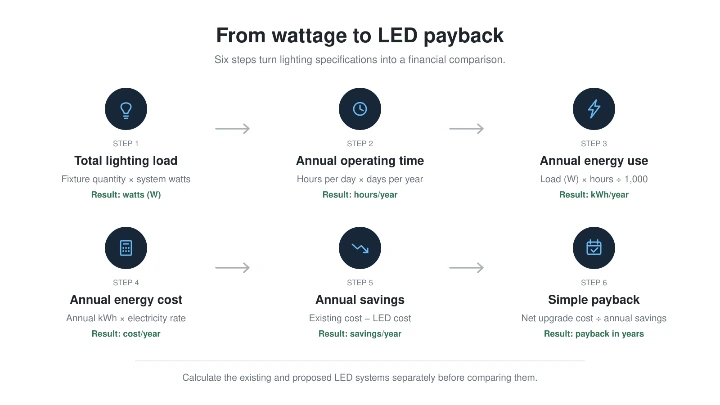
Step 1: Calculate total connected wattage
Total wattage = Fixture quantity × Wattage per fixture
If a shop uses 40 existing fixtures rated at 50W each:
40 × 50W = 2,000W
Step 2: Convert watts to kilowatts
Total kilowatts = Total wattage ÷ 1,000
2,000W ÷ 1,000 = 2kW
Step 3: Calculate annual operating hours
If the shop operates its lighting for 10 hours per day and 300 days per year:
Annual operating hours = 10 × 300 = 3,000 hours
Use the actual operating schedule where possible. Avoid automatically using 365 days for businesses that close on weekends, holidays or during seasonal periods.
Step 4: Calculate annual energy consumption
Annual energy use = Total kilowatts × Annual operating hours
2kW × 3,000 hours = 6,000kWh per year
The existing lighting system therefore consumes approximately 6,000kWh annually under this operating schedule.
The complete formula can also be written as:
Annual energy use in kWh = Fixture quantity × System wattage × Daily operating hours × Operating days per year ÷ 1,000
This existing-system result becomes the baseline against which the proposed LED system will be compared.
5. Calculate the Proposed LED Energy Use
Now apply the same method to the proposed LED system.
The operating schedule and fixture quantity should remain the same unless the lighting design also changes. This keeps the comparison fair and shows how much of the saving comes from reduced wattage.
Using the previous example:
- Existing fixtures: 40
- Existing system wattage: 50W per fixture
- Proposed LED fixtures: 40
- Proposed LED system wattage: 12W per fixture
- Annual operating time: 3,000 hours
Step 1: Calculate the proposed connected load
Proposed LED wattage = Fixture quantity × LED system wattage
40 × 12W = 480W
Step 2: Convert watts to kilowatts
480W ÷ 1,000 = 0.48kW
Step 3: Calculate annual LED energy consumption
Annual LED energy use = Total LED kilowatts × Annual operating hours
0.48kW × 3,000 hours = 1,440kWh per year
The proposed LED system would therefore consume approximately 1,440kWh annually, compared with 6,000kWh for the existing lighting.
If the proposed design changes the number of fixtures, calculate it using the new quantity. Do not assume that every existing lamp or fixture will be replaced one for one.
6. Calculate the Annual Energy Savings
Annual energy savings are found by subtracting the proposed LED consumption from the existing lighting consumption.
Annual energy savings = Existing annual energy use − Proposed annual energy use
Using the example:
6,000kWh − 1,440kWh = 4,560kWh saved per year
Calculate the energy-saving percentage
The percentage reduction helps compare projects of different sizes.
Energy-saving percentage = Annual kWh saved ÷ Existing annual kWh × 100
4,560 ÷ 6,000 × 100 = 76%
In this example, the LED replacement reduces calculated lighting energy consumption by 76%.
This percentage relates only to the lighting systems included in the comparison. It does not mean that the building’s total electricity consumption will fall by 76%, because cooling, heating, equipment and other electrical loads remain separate.
Check what produced the saving
The reduction may come from:
- Lower fixture wattage
- Fewer fixtures
- Shorter operating hours
- Occupancy or scheduling controls
- Dimming during part of the operating period
If several changes are introduced together, record them clearly so the result can be checked later.
7. Convert Energy Savings into Electricity Cost Savings
Energy consumption is measured in kilowatt-hours, but financial savings depend on the cost of each kilowatt-hour.
Annual electricity cost = Annual energy use × Electricity rate
For this example, assume an effective electricity rate of $0.20 per kWh.
Existing annual lighting cost
6,000kWh × $0.20 = $1,200 per year
Proposed LED annual lighting cost
1,440kWh × $0.20 = $288 per year
Annual electricity saving
$1,200 − $288 = $912 per year
The same result can be calculated directly:
4,560kWh saved × $0.20 = $912 per year
Which electricity rate should you use?
Use the rate that represents the actual cost of supplying the property.
Where electricity comes from more than one source or the tariff changes by usage level or time, calculate an effective blended rate:
Effective electricity rate = Total electricity cost ÷ Total kWh consumed
For example, if the property paid $1,800 for 9,000kWh during a representative period:
$1,800 ÷ 9,000kWh = $0.20 per kWh
Use a representative billing period rather than one unusually high or low month. If future electricity prices are uncertain, calculate more than one scenario instead of presenting a single result as guaranteed.
| Electricity rate | Annual energy saving | Annual cost saving |
|---|---|---|
| $0.15/kWh | 4,560kWh | $684 |
| $0.20/kWh | 4,560kWh | $912 |
| $0.25/kWh | 4,560kWh | $1,140 |
| $0.30/kWh | 4,560kWh | $1,368 |
The physical energy saving remains 4,560kWh in every scenario. Only its financial value changes.
8. Calculate the Simple Payback Period
The simple payback period estimates how long the annual savings will take to recover the initial upgrade cost.
Simple payback period = Net upgrade cost ÷ Annual savings
Assume the LED upgrade costs $2,400, including the fixtures and installation.
Using energy savings alone:
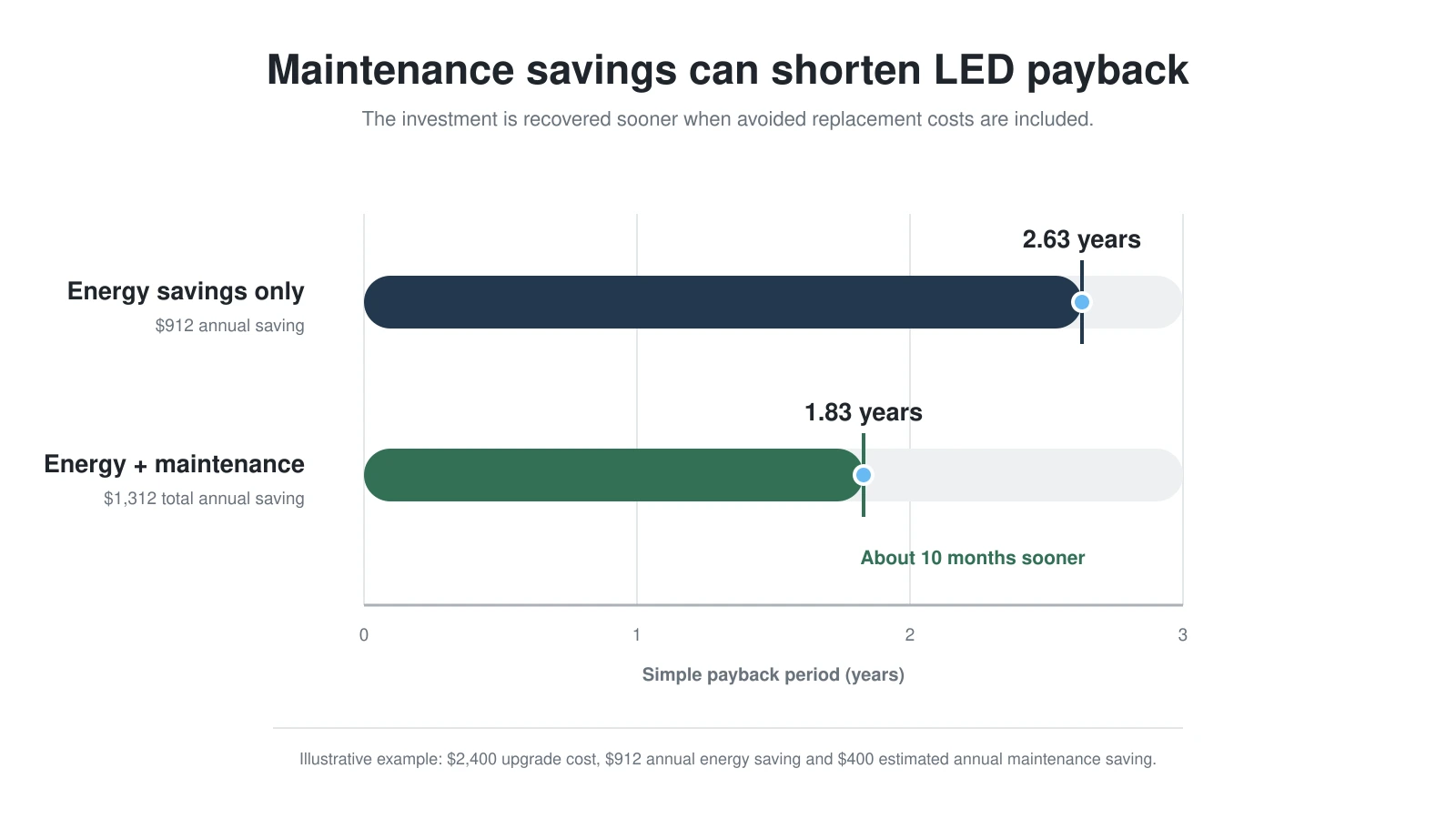
$2,400 ÷ $912 = 2.63 years
The calculated simple payback period is therefore approximately:
2.6 years, or about 32 months
After this point, the accumulated electricity savings become greater than the initial upgrade cost, provided that the operating hours, electricity rate and system performance remain reasonably close to the assumptions.
Use net upgrade cost where appropriate
For a planned renovation or replacement, part of the spending may have occurred even without the LED upgrade. In that case, the payback calculation can use the additional cost specifically associated with choosing the more efficient option.
Net upgrade cost = LED project cost − Avoided conventional replacement cost − Applicable incentives
For a direct retrofit undertaken only to reduce operating costs, the full purchase and installation cost will normally form the starting investment.
What simple payback includes
A basic energy-only payback calculation includes:
- Initial lighting and installation cost
- Annual electricity cost before the upgrade
- Annual electricity cost after the upgrade
It does not automatically include:
- Financing costs
- Future electricity-rate changes
- Maintenance savings
- Cooling-system effects
- Changes in operating hours
- Differences in product life
- Residual or disposal value
These factors can be added for a broader financial assessment, but simple payback remains useful as a clear first comparison.
9. Residential LED Replacement Example
The same method can be applied to a smaller residential upgrade.
Assume a home replaces 12 incandescent lamps rated at 60W with 12 LED lamps rated at 9W. The lights operate for an average of four hours per day.
Project inputs
| Input | Existing lighting | Proposed LED |
|---|---|---|
| Lamp quantity | 12 | 12 |
| Wattage per lamp | 60W | 9W |
| Daily operating time | 4 hours | 4 hours |
| Operating days | 365 | 365 |
| Electricity rate | $0.20/kWh | $0.20/kWh |
Existing annual energy use
12 × 60W × 4 hours × 365 days ÷ 1,000 = 1,051.2kWh
Proposed LED annual energy use
12 × 9W × 4 hours × 365 days ÷ 1,000 = 157.7kWh
Annual energy saving
1,051.2kWh − 157.7kWh = 893.5kWh
Annual electricity saving
893.5kWh × $0.20 = $178.70 per year
If purchasing the LED lamps costs $120:
$120 ÷ $178.70 = 0.67 years
The energy-only payback is approximately eight months.
10. Include Maintenance and Replacement Savings
Electricity is usually the clearest saving, but it may not be the only one.
Older lamps may require more frequent replacement, particularly where lighting operates for long hours. Every replacement can involve:
- A new lamp or component
- Maintenance labour
- Access equipment
- Disruption to the space
- Disposal and administration
These costs can be important in shops, offices, hotels, restaurants, staircases, high ceilings and exterior installations.
Estimate annual maintenance costs
A simplified maintenance estimate can be calculated as:
Annual maintenance cost = Expected annual replacements × Cost per replacement
The cost per replacement may include:
Replacement product + Labour + Access cost
Calculate this separately for the existing and proposed systems.
Annual maintenance saving = Existing maintenance cost − Proposed LED maintenance cost
If the existing system costs $500 per year to maintain and the LED system is expected to cost $100 per year:
$500 − $100 = $400 annual maintenance saving
Add maintenance to the business case
Total annual saving = Electricity saving + Maintenance saving
Using the earlier commercial example:
$912 electricity saving + $400 maintenance saving = $1,312 total annual saving
The broader simple payback becomes:
$2,400 ÷ $1,312 = 1.83 years
Including maintenance reduces the estimated payback from 2.63 years to approximately 1.8 years.
Maintenance assumptions should be based on realistic replacement history, product specifications and installation conditions. Rated product life is useful for comparison, but it is not a guarantee that every lamp or luminaire will operate for exactly that number of hours.
11. How Lighting Controls Affect Energy Savings
An efficient fixture can still waste energy if it remains on when the space is empty or when daylight already provides enough illumination.
Lighting controls can reduce operating hours or lower the average power used by the system.
Occupancy and motion sensors
Occupancy sensors can switch or dim lighting when a room or circulation area is unoccupied. They are most useful where usage is intermittent, such as:
- Meeting rooms
- Bathrooms
- Storage rooms
- Corridors
- Staircases
- Parking and service areas
Timers and schedules
Scheduled controls can prevent lighting from remaining on outside normal operating hours. This is particularly useful for retail displays, signage, offices, exterior lighting and common areas.
Daylight-responsive control
Where daylight is available, sensors or control systems can dim or switch selected lighting zones without affecting darker parts of the space.
Dimming
Dimming reduces energy consumption when compatible LED luminaires, drivers and controls are used. The power reduction may not always follow the dimming percentage exactly, so measured data or manufacturer information provides a better estimate than assuming a perfectly proportional relationship.
Avoid double-counting control savings
If the existing lighting already uses the same controls and schedule, do not claim those savings again as part of the LED upgrade.
When controls are added with the new LED system, calculate the existing and proposed operating profiles separately:
Existing annual energy use in kWh = Existing load in kW × Existing annual operating hours
Proposed annual energy use in kWh = Proposed load in kW × Adjusted annual operating hours
The lower LED wattage and the reduced operating time can then be included in the same comparison without counting either saving twice.
12. When an LED Upgrade May Have a Weak Payback
LED replacement does not automatically produce a short payback period.
The financial case may be weaker when:
The lights operate for very few hours
A lamp used occasionally consumes little annual energy, even when its wattage is relatively high. The yearly saving may therefore be too small to recover the replacement cost quickly.
The existing lighting is already efficient
Replacing an older halogen or incandescent system can create a large wattage reduction. Replacing a relatively efficient existing LED system may produce only a small improvement.
The wattage difference is small
If the existing and proposed fixtures have similar system wattages, the energy saving will remain limited unless the new design also reduces fixture quantity or operating hours.
Installation costs are high
Ceiling modifications, rewiring, difficult access, control-system upgrades or specialised installation work can increase the initial project cost and extend payback.
The electricity rate is low
A lower electricity rate reduces the financial value of each kilowatt-hour saved. The energy reduction remains the same, but it takes longer for the cost saving to recover the investment.
The proposed lighting is over-specified
Installing more light than the space needs can reduce or eliminate the expected saving. Fixture quantity, output and distribution should be planned around the actual lighting requirement.
The upgrade is evaluated only through payback
A project with a longer energy payback may still be justified when the existing lighting has poor colour rendering, excessive glare, visible flicker, unreliable components or high maintenance requirements.
In these cases, the decision includes lighting quality, reliability and operational needs as well as electricity savings.
13. Simple Payback, ROI and NPV
Simple payback shows how quickly the initial investment may be recovered. ROI and NPV provide a broader view across a defined study period.
However, it does not describe the project’s complete financial performance over its operating life.
Return on investment
Return on investment measures the project’s cumulative net benefit relative to the initial investment over a defined study period.
Cumulative net benefit = Total savings over the study period − Net project cost
ROI = Cumulative net benefit ÷ Net project cost × 100
Using the commercial example over five years, with no escalation or discounting:
Five-year savings = $912 × 5 = $4,560
Cumulative net benefit = $4,560 − $2,400 = $2,160
Five-year ROI = $2,160 ÷ $2,400 × 100 = 90%
ROI must always state its evaluation period. A one-year result and a five-year result are not directly comparable.
Net present value
Net present value, or NPV, is the present value of projected future savings minus the net initial investment.
NPV can help compare projects with different costs, savings patterns or evaluation periods. It is more complete than simple payback, but it also requires additional assumptions, including:
- Evaluation period
- Discount rate
- Future electricity costs
- Maintenance costs
- Replacement timing
- Residual value
For an initial lighting decision, simple payback is often the clearest starting point. ROI and NPV can then provide a broader financial view when the project requires one.
14. Use the LED Lighting Cost & Energy Savings Calculator
The formulas in this guide can be calculated automatically using the Saleh Deco LED Lighting Cost & Energy Savings Calculator.
The calculator compares existing and proposed lighting using fixture quantity, system wattage, operating schedules, electricity rates, project costs and optional maintenance assumptions. It estimates energy use, operating cost, annual savings, simple payback and, in Professional mode, ROI and NPV.
Calculate LED Lighting Savings →
Use the result as a preliminary comparison. The final project decision should also consider the selected products, lighting performance, installation conditions and actual operating schedule.
15. LED Upgrade Calculation Checklist
Before accepting an energy-saving or payback result, confirm the following information.
Existing lighting
Fixture or lamp quantity is correct
Wattage represents the complete existing system
Ballast or control-gear losses are included where applicable
Actual operating hours are used
Existing controls and schedules are recorded
Current maintenance costs are estimated realistically
Proposed LED system
Proposed fixture quantity reflects the new layout
Wattage represents the complete LED luminaire or lamp
The proposed system provides suitable light output
Beam angle and distribution suit the application
Colour temperature and colour rendering are appropriate
Glare, flicker and dimming compatibility have been checked
- The proposed operating schedule includes any new controls
Product and installation costs are included
Financial assumptions
Electricity rate reflects the property’s actual supply cost
Mixed electricity sources use a representative blended rate
Energy and maintenance savings are shown separately
Upgrade cost is not confused with annual operating cost
Any avoided replacement cost is documented
Payback assumptions use the same units and time period
Alternative electricity-rate scenarios are tested where useful
A calculation is only as reliable as the information entered. Clearly recording the assumptions makes the result easier to verify and update.
16. Frequently Asked Questions
How much electricity can LED lighting save?
The saving depends on the difference between the existing and proposed system wattage, fixture quantity and operating schedule.
Calculate both systems separately:
Annual kWh = Quantity × System wattage × Annual operating hours ÷ 1,000
Then subtract the proposed LED consumption from the existing consumption.
What is a good LED lighting payback period?
There is no single payback period that suits every project. A building owner may prioritise a short financial return, while another project may accept a longer payback to improve lighting quality, reliability or maintenance access.
The result should be compared with the organisation’s investment criteria and the expected useful life of the installation.
Should maintenance savings be included?
Yes, when they can be estimated from credible replacement history, labour costs and access requirements.
Show maintenance separately from electricity savings so the business case remains transparent.
Can I calculate savings when replacing existing LED lighting?
Yes. Compare the actual system wattage and operating conditions of the existing and proposed LED systems.
The saving may be smaller than when replacing incandescent, halogen or older discharge lighting, but improved optics, controls or fixture layout may still reduce total connected load.
Which electricity rate should I enter?
Use the effective cost paid for each kilowatt-hour.
Where a property uses multiple supply sources or changing tariffs, divide the representative total electricity cost by the total energy consumed:
Effective rate = Total electricity cost ÷ Total kWh
Is lower wattage enough to confirm a suitable replacement?
No. The replacement must also provide appropriate light output, distribution, colour quality, visual comfort and control compatibility.
A fixture that uses less energy but does not meet the lighting requirement is not an equivalent replacement.
17. Make the Decision from Comparable Information
Reliable LED savings calculations compare the complete existing and proposed systems using actual wattage, operating hours, electricity rates, project costs and documented maintenance assumptions.
Apply the calculation to your actual office, retail or restaurant and café lighting plan. Compare replacement lighting products only after checking equivalent output, distribution, colour quality and controls.
Use the LED Lighting Cost & Energy Savings Calculator to apply these calculations to your project, then confirm that the proposed lighting also provides suitable output, distribution and visual comfort.
Related Lighting Guides and Tools
- Lux and Lumens Lighting Guide — determine how much light the space requires before comparing fixture wattages.
- Light Quality Explained — understand CRI, R9, colour consistency, glare and flicker before selecting replacement lighting.
- Explore All Lighting Tools — calculate light levels, beam spread, fixture layouts, LED strip power and other project requirements.