
Magnetic track lighting is usually the better choice when flexibility, modularity and future changes are important. Recessed spotlights are generally better when you want a clean, discreet ceiling with a lighting layout that will remain largely unchanged.
Magnetic systems use a powered track with compatible modules that can be moved, replaced or added within the installed system. Recessed spotlights are fitted individually into fixed ceiling openings, creating a quieter appearance but offering less flexibility after installation.
Neither system is universally better. The right choice depends on the ceiling design, required lighting functions, installation stage, budget and whether the room layout may change over time. In some projects, combining both systems creates the strongest result.
Quick Decision: Which System Should You Choose?
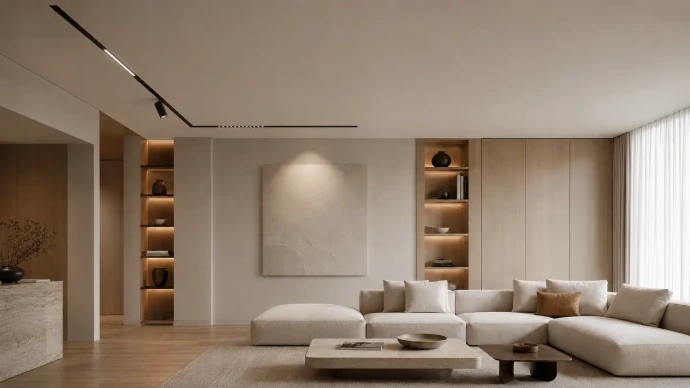
Choose Magnetic Track Lighting If:
- You want to move or reposition lighting modules.
- Your furniture, artwork or displays may change.
- You need general, task and accent lighting within one system.
- You want the track to become a visible architectural feature.
- You may want to add compatible modules later.
Best for: living rooms, showrooms, retail spaces, flexible offices and evolving interiors.
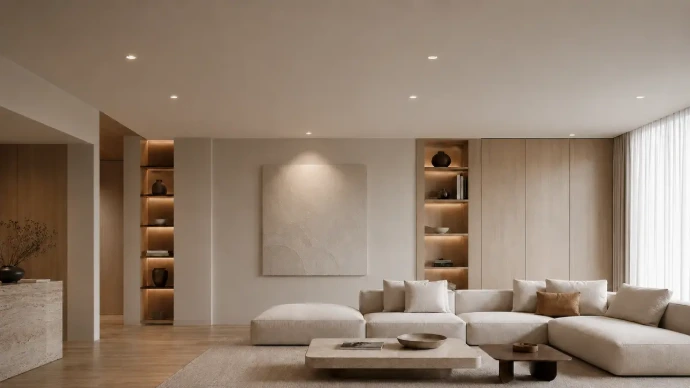
Choose Recessed Spotlights If:
- You want the cleanest and most discreet ceiling appearance.
- Your lighting positions are already carefully planned.
- You expect the room layout to remain largely unchanged.
- You prefer individual fixed or adjustable lighting points.
- You want trimless fixtures integrated into the ceiling.
Best for: bedrooms, corridors, kitchens, bathrooms and minimalist interiors.
Still unsure? Choose magnetic track lighting when adaptability matters most, recessed spotlights when ceiling simplicity is the priority, or combine both when you need discreet general lighting with flexible accent lighting.
In This Guide
Use the links below to compare both systems or jump directly to the section most relevant to your project.
› What Is Magnetic Track Lighting?
› Which Is Better for Each Room?
› What Are Recessed Spotlights?
› Can You Combine Both Systems?
› Flexibility and Future Changes
What Is Magnetic Track Lighting?
Magnetic track lighting is a modular lighting system built around a powered track and a selection of compatible lighting modules. Instead of installing each fixture into a separate ceiling opening, the modules connect directly inside the track.
A typical magnetic system includes:
- A surface-mounted, recessed or suspended track profile.
- A driver that supplies the system with low-voltage power.
- Linear modules for soft general lighting.
- Grille modules for controlled directional lighting.
- Adjustable spotlights for highlighting artwork, furniture or displays.
The main advantage is flexibility. Compatible modules can be repositioned, replaced or added within the installed track as the room layout or lighting requirements change. This allows one system to provide general, task and accent lighting without creating additional ceiling openings for every fixture.
Magnetic components are not universally interchangeable. The track, driver, connectors and lighting modules must belong to the same compatible system and operate within its supported electrical capacity.
Magnetic track lighting is especially useful in living rooms, offices, showrooms and retail spaces where furniture, artwork or displays may change over time. Visually, the track becomes part of the ceiling design, creating a stronger architectural appearance than individually recessed spotlights.
Browse Saleh Deco’s modular lighting systems to compare tracks, drivers, connectors and compatible lighting modules.
Key advantage: The lighting layout can evolve within the installed track without redesigning the entire ceiling.
What Are Recessed Spotlights?
Recessed spotlights are individual light fixtures installed inside openings in the ceiling. Most of the fixture body remains concealed above the finished surface, leaving only the spotlight face or opening visible from below.
Common recessed spotlight types include:
- Fixed spotlights that direct light straight downward.
- Adjustable spotlights that can be aimed toward walls, artwork or specific areas.
- Deep-recessed models that reduce glare by positioning the light source further inside the fixture.
- Trimless spotlights that are plastered into the ceiling for the cleanest integrated appearance.
- Replaceable-lamp frames and complete integrated LED fixtures.
The main visual advantage is discretion. Because each fixture is installed separately and no continuous track remains visible, recessed spotlights can create a calm, clean ceiling—particularly when white or trimless models are used.
Their positions must be carefully planned before ceiling work is completed. Once the openings, wiring points and trimless frames are installed, changing the layout may require new electrical work, ceiling cutting, plaster repair and repainting.
Recessed spotlights are especially suitable for bedrooms, corridors, kitchens, bathrooms and minimalist interiors where the furniture arrangement and lighting plan are unlikely to change significantly.
Explore Saleh Deco’s recessed and technical spotlights to compare fixed, adjustable, trimless and integrated options.
Key advantage: Recessed spotlights provide focused lighting while preserving a clean and visually discreet ceiling.
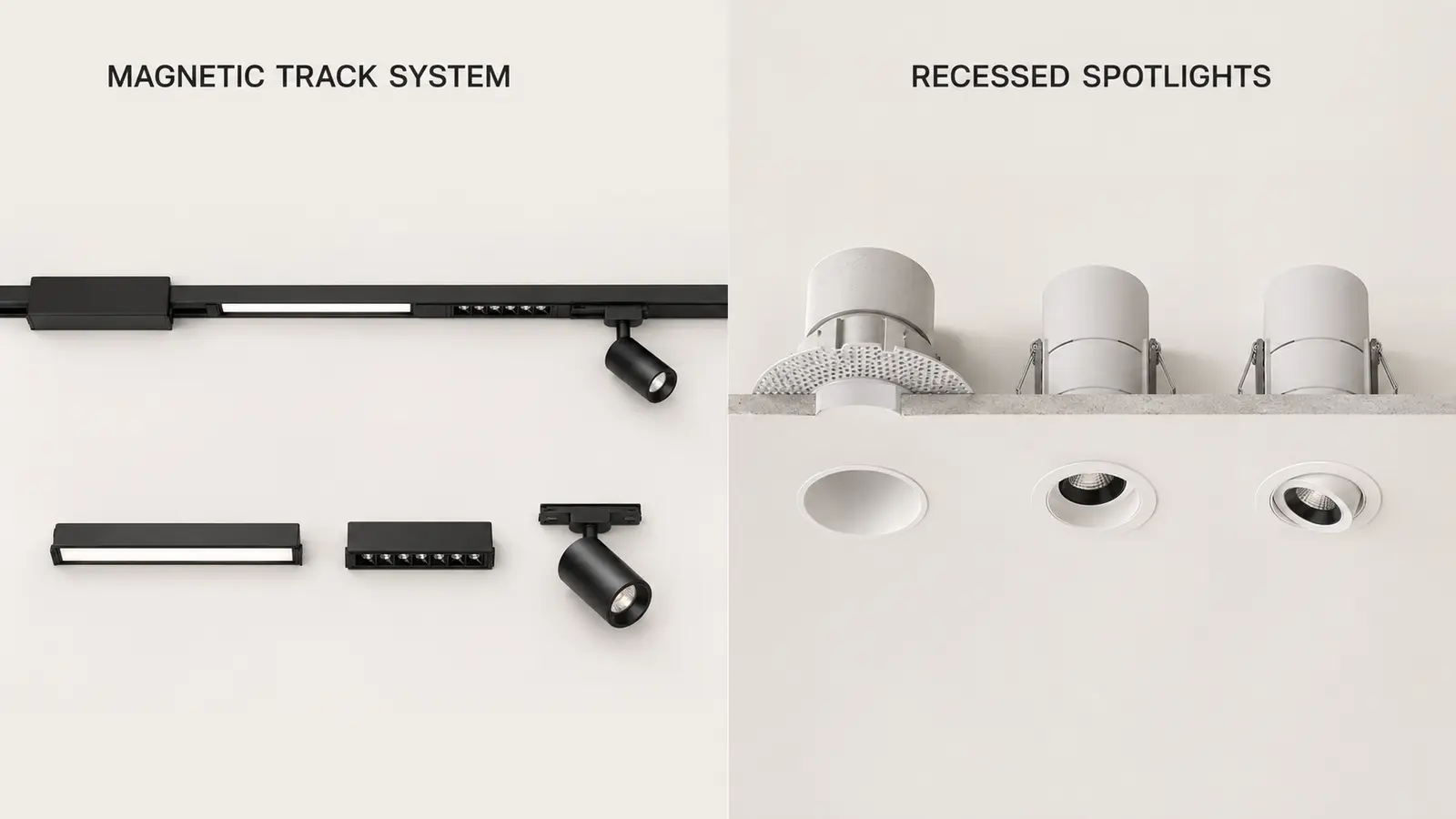
Quick Comparison: Magnetic Track Lighting vs Recessed Spotlights
The main difference is adaptability: magnetic track lighting allows compatible modules to be repositioned or replaced within the installed track, while recessed spotlights create a cleaner ceiling but remain tied to individually planned installation points.
| Factor | Magnetic Track Lighting | Recessed Spotlights |
|---|---|---|
| Ceiling appearance | Visible architectural track | Clean, discreet individual fixtures |
| Flexibility | Compatible modules can be moved, replaced or added within the track | Fixture positions remain tied to the original ceiling openings |
| Lighting functions | Can combine linear, grille and adjustable modules within one compatible system | Each fixture provides a defined fixed or adjustable light point |
| Installation planning | Requires compatible track, modules, connectors and driver | Requires individual ceiling openings, wiring points and compatible drivers where applicable |
| Future changes | Easier to adapt when furniture, artwork or displays change | Layout changes may require ceiling cutting, rewiring, plaster repair and repainting |
Initial cost | Usually higher because it is a complete modular system | Usually lower for a conventional fixed layout |
| Visual style | Graphic, modern and architectural | Minimal, calm and integrated |
| Best suited to | Flexible living spaces, offices, showrooms and retail interiors | Bedrooms, corridors, kitchens, bathrooms and minimalist interiors |
| Main limitation | Components must belong to the same compatible system | Fixture locations are more difficult to change after installation |
Quick verdict: Choose magnetic track lighting when adaptability matters most. Choose recessed spotlights when a clean ceiling and a stable lighting layout are the priority.
Ceiling Appearance: Visible Structure or Discreet Lighting?
The clearest visual difference between magnetic track lighting and recessed spotlights is how much of the lighting system remains visible. This affects the character of the ceiling even when both systems produce similar brightness and colour temperature.
Magnetic Track Lighting
Magnetic track lighting remains intentionally visible as a continuous architectural line. A black track can create contrast against a white ceiling, frame a seating area or reinforce the direction of a corridor.
The final appearance depends on:
- Whether the track is surface-mounted, recessed or suspended.
- The colour, width and layout of the track.
- The number and type of lighting modules used.
- How carefully corners, connectors and termination points are planned.
A restrained layout with properly spaced modules can look refined and architectural. Too many modules, unnecessary track lines or poorly positioned corners can make the ceiling appear visually crowded.
Recessed Spotlights
Recessed spotlights create a quieter ceiling because each fixture is installed separately and most of its body remains concealed. White fixtures blend into light-coloured ceilings, while trimless models provide an even more integrated plaster-in finish.
Their visual result depends on:
- Consistent spacing and alignment.
- Appropriate fixture size for the room.
- Whether fixed, adjustable or deep-recessed models are used.
- The quality of the ceiling cutting, plastering and finishing.
- Avoiding more spotlight openings than the room requires.
Recessed spotlights suit interiors where the ceiling should remain calm and secondary to the furniture, materials or decorative lighting.
Design distinction: Magnetic track lighting becomes part of the architecture, while recessed spotlights are designed to visually disappear into the ceiling.
Flexibility and Future Changes
Lighting plans often need to adapt when furniture moves, artwork changes or a room takes on a new function. This is where the practical difference between the two systems becomes most noticeable.
Magnetic Track Lighting
Magnetic track lighting is designed around a permanent powered track with interchangeable compatible modules. Depending on the system, linear lights, grille modules and adjustable spotlights can be repositioned or replaced without creating new ceiling openings.
This flexibility is useful when:
- A living-room layout may change.
- Artwork or decorative features are replaced.
- Retail displays are rearranged regularly.
- A showroom needs different products highlighted.
- A workspace develops new task-lighting requirements.
- Additional compatible modules may be needed later.
The installed track defines where modules can be positioned, so it does not provide unlimited freedom across the entire ceiling. Any added modules must also remain compatible with the track and within the driver’s supported electrical capacity.
Recessed Spotlights
Recessed spotlights are less adaptable because each fixture is connected to a specific ceiling opening and wiring point. Adjustable models can redirect their beam, but the physical position of the fixture remains unchanged.
Moving or adding recessed spotlights may require:
- Creating new ceiling openings.
- Extending or relocating electrical wiring.
- Removing unused fixtures or closing old openings.
- Repairing plaster or gypsum.
- Repainting the affected ceiling area.
- Realigning the complete spotlight layout.
This is not a disadvantage when the room arrangement and lighting plan are already settled. A carefully planned recessed layout can remain effective for many years without needing modification.
Planning principle: Choose magnetic track lighting when the space is expected to evolve. Choose recessed spotlights when the layout is established and ceiling simplicity matters more than future repositioning.
Installation and Ceiling Requirements
Both systems require early planning, but their installation requirements differ. The correct choice depends not only on appearance, but also on the ceiling type, available ceiling depth, electrical access and the stage of the project.
Once you have chosen a modular system, use the Modular & Magnetic Track Lighting Planning Guide for track geometry, feeds, drivers and compatibility, then prepare a layout with the Modular Lighting Planner.
Magnetic Track Lighting
A magnetic lighting system requires a compatible track, driver, connectors and lighting modules. The installation method depends on the chosen track type:
- Surface-mounted tracks attach below the finished ceiling and usually require less ceiling alteration.
- Recessed tracks are integrated into gypsum or plaster ceilings for a cleaner architectural finish.
- Trimless recessed tracks require precise plastering so the track edges become concealed within the ceiling.
- Suspended tracks hang below the ceiling and can suit high ceilings, offices, showrooms and spaces with exposed services.
Recessed and trimless magnetic tracks must be planned before the ceiling is completed. The installer needs sufficient ceiling depth for the profile and driver, correctly positioned electrical feeds, suitable support and accessible locations for components that may require future maintenance.
The complete system should be selected together. Track dimensions, operating voltage, driver capacity, connectors and modules must all be compatible.
Recessed Spotlights
Recessed spotlights require an individual ceiling opening and electrical connection for every fixture. Their installation requirements depend on the spotlight’s dimensions and construction.
Important considerations include:
- The required ceiling cut-out diameter or shape.
- The fixture’s installation depth above the finished ceiling.
- Clearance around the body, driver and electrical connections.
- Fixed versus adjustable spotlight construction.
- Access to replace lamps, drivers or complete fixtures.
- Accurate spacing and alignment across the ceiling.
- Additional plastering requirements for trimless models.
Standard recessed frames can usually be installed after the ceiling openings are prepared. Trimless spotlights must be fitted before the final plastering and painting stages so their installation plates become completely concealed.
In concrete ceilings without a suspended gypsum layer, creating recessed openings and concealing drivers may be considerably more restrictive. Surface-mounted fixtures or surface magnetic tracks can sometimes provide a more practical solution.
Plan Before Closing the Ceiling
Before finalizing either system, confirm:
- Ceiling construction: concrete, gypsum, plaster or suspended ceiling.
- Available depth above the finished surface.
- Track routes or spotlight positions.
- Driver locations and future maintenance access.
- Furniture, artwork and decorative-lighting positions.
- Switching, dimming and control requirements.
- Compatibility of every system component.
For a preliminary recessed-lighting arrangement, use our Spotlight Layout Calculator to estimate spotlight quantity, spacing, wall offsets and beam coverage.
Installation principle: Surface-mounted systems offer greater flexibility in finished spaces, while recessed and trimless systems should be coordinated before the ceiling is plastered and painted.
Which System Performs Better?
Neither system automatically produces better light. Performance depends mainly on the selected fixtures, their specifications, positioning and how well the complete lighting plan suits the room.
Brightness and Light Distribution
Magnetic track lighting can combine several module types within one system:
- Linear modules for wider, softer illumination.
- Grille modules for controlled directional light.
- Adjustable spotlights for focused accents.
- Pendant modules for decorative or task lighting, where compatible.
This makes it easier to layer general, task and accent lighting along the same track.
Recessed spotlights create individual pools of light from fixed ceiling positions. Their distribution depends on the beam angle, spacing, ceiling height and whether the fixtures are fixed or adjustable. A well-planned recessed layout can provide excellent general and accent lighting without introducing a visible track.
The required quantity varies by room size, lumen output, ceiling height and layout; see how many spotlights a room needs for the complete planning method.
Beam Control and Accent Lighting
Both systems can provide precise directional lighting when fitted with suitable adjustable modules.
- Narrower beam angles create concentrated accents for artwork, displays and architectural details.
- Medium beam angles suit general residential spotlighting.
- Wider beam angles distribute light more broadly and help reduce harsh pools of illumination.
Magnetic systems make accent positions easier to revise later. Adjustable recessed spotlights can redirect their beams, but their ceiling positions remain fixed.
Glare and Visual Comfort
Glare depends more on fixture design and placement than on the system itself. Deep-set light sources, dark internal reflectors, anti-glare optics and appropriate beam angles can improve visual comfort in both magnetic modules and recessed spotlights.
Poorly positioned fixtures may create glare when aimed toward seating areas, mirrors, televisions or common sightlines. Using too many exposed light sources can also make a room feel visually harsh even when the measured brightness is adequate.
Light Quality and Controls
When comparing products, evaluate:
- Colour temperature, including the choice between 3000K and 4000K lighting.
- Colour rendering index (CRI).
- Lumen output rather than wattage alone.
- Beam angle and optical control.
- Dimming compatibility.
- Driver quality and expected service life.
- Flicker performance where this information is available.
These factors determine the quality and usability of the lighting more directly than whether the fixture belongs to a magnetic or recessed system.
Performance verdict: Magnetic track lighting offers greater freedom to combine and reposition different lighting functions. Recessed spotlights can deliver equally effective illumination when their positions, beam angles and spacing are planned correctly.
Which Is Better for Each Room?
The best system depends on whether the room needs future flexibility, a visually discreet ceiling or a combination of general and accent lighting. The following recommendations provide a practical starting point.
Living Rooms
Magnetic track lighting is often the more flexible option because it can combine general lighting with adjustable accents for artwork, wall textures, shelves and seating areas. Modules can also be repositioned if the furniture layout changes.
Recessed spotlights are better when the ceiling should remain visually calm and the furniture arrangement is already established.
Best choice: Magnetic track lighting for flexibility; recessed spotlights for minimalism.
Kitchens
Recessed spotlights provide clean, evenly distributed general lighting and work well above circulation areas. Additional task lighting may still be required above worktops, sinks and kitchen islands.
Magnetic track lighting can be useful in open kitchens where adjustable modules need to serve counters, cabinets and dining areas from one coordinated system.
Best choice: Recessed spotlights for straightforward general lighting; magnetic tracks for open or multifunctional kitchens.
Bedrooms
Recessed spotlights usually suit bedrooms because they preserve a quieter ceiling and can complement bedside lamps, pendants or concealed lighting.
Magnetic tracks can work in contemporary bedrooms, particularly when adjustable lighting is needed for wardrobes, artwork or reading areas. The layout should remain restrained to avoid making the ceiling feel overly technical.
Best choice: Recessed spotlights for most bedrooms.
Corridors and Entrances
Recessed spotlights create a clean rhythm along corridors and work well when the route is fixed.
Magnetic track lighting becomes useful when entrances contain artwork, decorative walls, consoles or displays that may require adjustable accent lighting.
Best choice: Recessed spotlights for simple circulation; magnetic tracks for display-focused entrances.
Bathrooms
Recessed spotlights are generally easier to integrate into compact bathroom ceilings. Fixture suitability must be selected according to the location, moisture exposure and required IP protection.
Magnetic track lighting is less commonly used in bathrooms unless the complete system is specifically suitable for that environment.
Best choice: Appropriately rated recessed spotlights.
Home Offices and Workspaces
Magnetic track lighting offers greater adaptability when desks, shelving or work zones may move. Linear modules can support general illumination, while adjustable modules can highlight working surfaces or storage.
Recessed spotlights remain suitable for fixed office layouts but should be positioned carefully to avoid glare on screens.
Best choice: Magnetic track lighting for changing layouts; recessed spotlights for established plans.
Showrooms and Retail Spaces
Magnetic track lighting is usually the stronger choice because products, displays and promotional areas change frequently. Adjustable modules can be moved or replaced as the merchandising layout evolves.
Recessed spotlights can support general lighting but offer less flexibility when display positions change.
Best choice: Magnetic track lighting.
Room-by-room verdict: Use recessed spotlights where the layout is stable and ceiling discretion matters most. Use magnetic track lighting where furniture, artwork, work zones or displays may change.
Can You Combine Magnetic Track Lighting and Recessed Spotlights?
Yes. Both systems can work effectively in the same interior when each has a distinct purpose.
How a Combined Plan Works
A balanced layout may use:
- Recessed spotlights for discreet general lighting and circulation.
- Magnetic linear modules for ambient illumination.
- Adjustable magnetic modules for artwork, feature walls or changing displays.
- Decorative lighting as the room’s visual focal point.
This combination works particularly well in open-plan homes, kitchens, offices, entrances and showrooms.
Keep the Ceiling Balanced
- Align tracks and spotlight rows with the architecture.
- Avoid placing different fixtures too close together.
- Coordinate their colour temperature and finishes.
- Use separate controls for different lighting layers.
- Do not use both systems for the same purpose in the same area.
Hybrid-lighting principle: Use recessed spotlights for discreet general lighting and magnetic tracks where adjustable or evolving illumination is valuable.
Cost and Long-Term Value
The final cost depends on fixture quality, installation method, number of lighting points and required ceiling work—not only on which system is selected.
Magnetic Track Lighting
Magnetic systems may have a higher initial cost because they require compatible tracks, drivers, connectors and modules. Their long-term advantage is adaptability: modules can often be moved, replaced or added without altering the ceiling.
Recessed Spotlights
Recessed spotlights can be more economical for a straightforward fixed layout. However, relocating or adding fixtures later may require new wiring, ceiling cutting, plaster repair and repainting.
Value principle: Recessed spotlights usually offer better value for stable layouts; magnetic track lighting can justify its higher initial cost when future flexibility is important.
Common Mistakes to Avoid
- Choosing fixtures before confirming the ceiling type and available installation depth.
- Mixing tracks, drivers, connectors or modules from incompatible magnetic systems.
- Installing too many track modules or recessed spotlights, creating glare and visual clutter.
- Planning light positions without considering furniture, artwork and working surfaces.
- Using narrow beams for general lighting or wide beams where focused accents are required.
- Forgetting future access to drivers and electrical components.
- Combining both systems without assigning each one a clear lighting purpose.
Avoid this: Do not choose between magnetic tracks and recessed spotlights based on appearance alone. Ceiling conditions, lighting needs and future flexibility should guide the decision.
Final Verdict: Which System Should You Choose?
Choose magnetic track lighting when flexibility, adjustable lighting and future layout changes are priorities.
Choose recessed spotlights when you want a clean, discreet ceiling and the room layout is already established.
Both systems can deliver excellent lighting when fixture quality, beam angles, spacing and installation are planned correctly.
Final recommendation: Let the room’s layout, ceiling conditions and future needs determine the system—not appearance alone.
Frequently Asked Questions
Neither is universally better. Magnetic track lighting offers greater flexibility, while recessed spotlights create a cleaner and more discreet ceiling.
Not always. Surface-mounted tracks can be installed below a finished ceiling, while recessed and trimless tracks normally require a gypsum or plaster ceiling with sufficient installation depth.
Compatible modules can usually be repositioned within the installed track. They must remain compatible with the track, operating voltage and driver capacity.
Recessed spotlights are often more economical for a simple fixed layout. Magnetic systems may cost more initially because they require tracks, drivers, connectors and compatible modules.
Yes, but installation may require new ceiling openings, wiring, plaster repair and repainting. This depends on the ceiling construction and available depth.
Yes. Recessed spotlights can provide discreet general lighting, while magnetic modules handle adjustable accent or task lighting.
No. Tracks, drivers, connectors and modules should belong to the same compatible system and operate at the correct voltage and electrical capacity.
Still Unsure Which Lighting System Fits Your Space?
The right choice begins with the ceiling conditions, room layout and lighting functions—not the fixture style alone.
Saleh Deco can help you compare compatible magnetic track systems, recessed spotlights, beam angles and colour temperatures for your residential or commercial project.
Continue exploring the Saleh Deco Lighting Guide for practical advice on spotlight planning, colour temperature, chandelier sizing and lighting-system selection.
Explore our lighting collections online or visit the Saleh Deco showroom for practical guidance and product selection.